欧博百家乐Understanding Internet Speeds: What Internet
Fast internet is generally between 100 to 300 Mbps download speed for most users and homes today. But figuring out what internet speed is considered fast can mean different speeds for different needs and households. The truth is that internet usage has changed dramatically over the past few years. Multiple family members streaming in different rooms, remote work video calls, smart home devices constantly connecting, and streaming 4K video all compete for bandwidth.
This creates real questions when you’re evaluating your current internet service or looking to upgrade it. What is a good internet speed? What internet speed is considered fast? How much internet speed do I need?
We'll answer all of these questions in this guide. You'll learn what counts as "fast" internet for today's online demands, how much speed different homes and activities need, and how to test your internet and figure out if it's time to upgrade.
Key Takeaways: What Internet Speed Is Considered Fast?[H2] What Is Internet Speed and How Is It Measured?
Internet speed is how fast data moves between your home and your provider’s broader network, measured in Mbps (megabits per second). With higher-tier plans, you might see Gbps (gigabits per second), which equals 1,000 Mbps.
Your internet connection is a two-way street: download (getting data to your devices) and upload (getting data to a location on the internet). Here are the online activities common to download and upload speeds:
Download speed affects streaming, browsing, app updates, and file downloads. This is the speed advertised in most plans.
Upload speed affects sending files, video calls, livestreaming, and cloud backups.
Upload speed is just as important as fast download speed for the way most people use the internet now. Maybe even more important, in some cases. For most internet connection types, upload speed is considerably slower than upload speed, but most fiber internet plans have equal download and upload speeds, known as symmetrical speeds. If you’re comparing plans, look at both to make sure you're getting what you need for activities like Zoom calls and sharing large files.
How Much Internet Speed Do I Really Need?You need enough speed to accommodate the number of people and devices that use your network connection at the same time, plus a little extra cushion for peak hours and Wi-Fi inefficiencies. A good starting point is at least 100 Mbps download, and 10 Mbps upload per person.
Use this internet speed comparison chart to find the right speed for your needs.
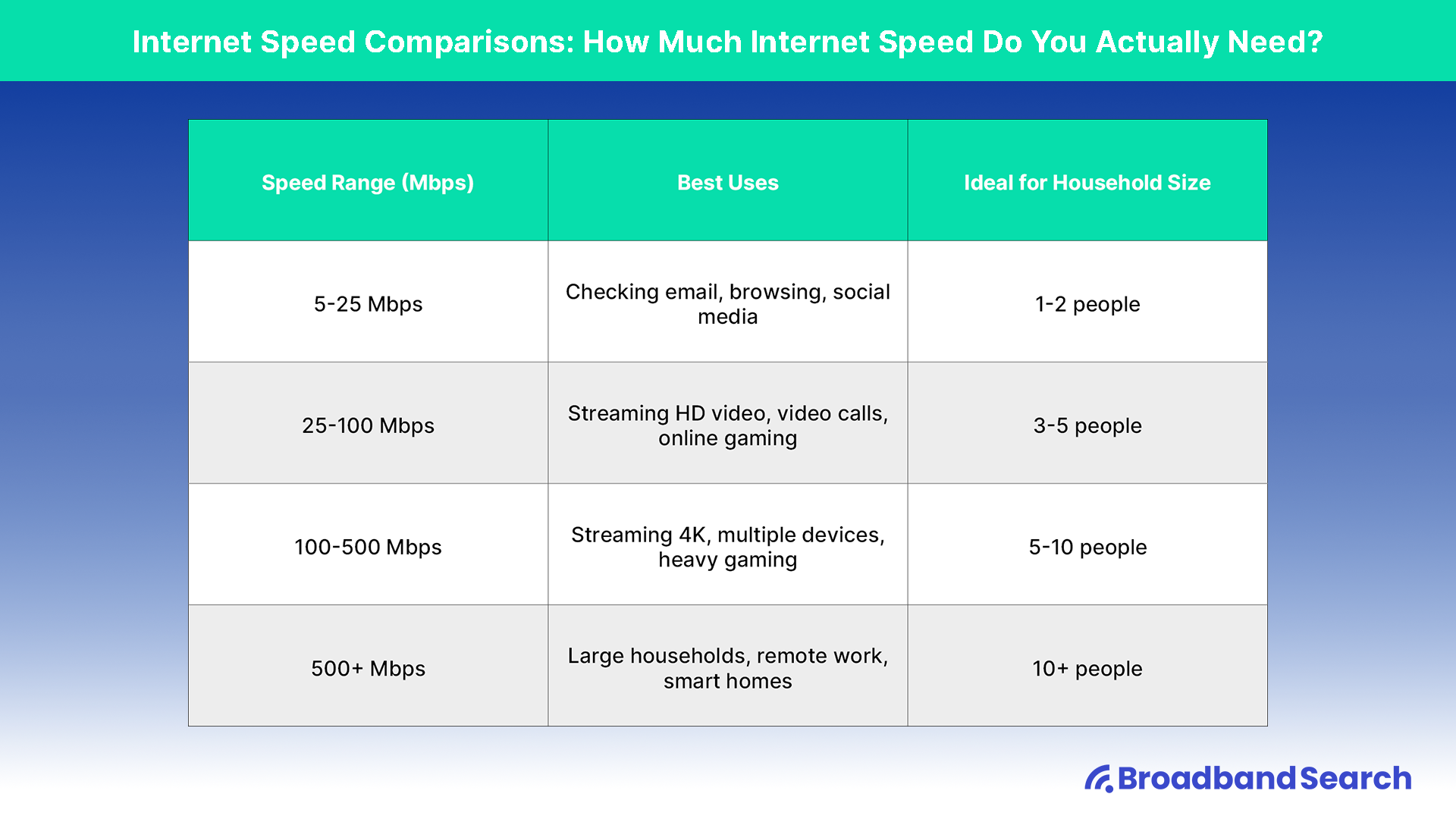
5 to 25 Email, web browsing, music streaming 1 to 2 people, few devices If HD streaming buffers or video calls stutter
25 to 100 HD streaming, casual gaming, video calls 2 to 4 people, moderate devices If multiple streams or meetings happen at once
100 to 300 Multiple HD or 4K streams, online gaming, WFH 3 to 6 people, lots of devices If lag shows up during peak use or you add more devices
300 to 500 Heavy streaming, large families, smart homes 5+ people, many devices If you WFH, stream 4K everywhere, or upload big files
500 to 1,000+ Power users, creators, frequent large uploads, many devices Big households, prosumers If you regularly push your network hard (uploads, cloud work, big downloads)
How to use this chart: Count the number of people in your home and your connected devices (phones, tablets, computers, smart TVs, security cameras, voice assistants, and gaming consoles all count). Find the row that matches your situation. If your streams buffer a lot buffering, have laggy video calls, or slow downloads, choose the next higher speed tier.
What Internet Speed Is Considered Fast Today?Fast internet today means at least 100 Mbps download and 10 - 20 Mbps upload for basic online needs. But these minimums need a little flavor. Sure, they align with the FCC broadband minimums of 100 Mbps download and 20 Mbps upload, but they trail behind many state and national averages.
As new technologies emerge and internet bandwidth demands rise, 100 Mbps download and 20 Mbps upload are entry level points. For example, Ookla shows that the U.S. median fixed-broadband performance in the 300 Mbps range.
While 100 Mbps download speed is considered fast today, we recommend at least 200 Mbps download, and 20 Mbps upload speed. This is enough bandwidth for 2-3 users and a few devices.
Upload Speed vs Download Speed: Why Both MatterDownload speed gets most of the attention, because most of what we do online involves getting data to our device, and fast upload speeds are easy to come by with most internet plans. But upload might be the reason your internet feels slow, and fast upload speeds are less common.
Your upload performance is noticeable during video calls, some online games, and cloud backups. If you notice poor internet performance during any of these, it’s probably due to slow upload speed. Quick benchmarks for a good upload speed:
5 to 10 Mbps upload: Fine for casual households and basic video calls.
20 to 35 Mbps+ upload: Better if you work from home, share large files, upload video, or livestream.
The problems with upload speed are that, for the most part, it is limited by the type of internet connection you have, and you probably can’t upgrade it like you can download speed. If upload matters a lot in your house, fiber internet is often the best option for its higher upload capacity than many cable internet or DSL plans.
Bandwidth, Latency, and Ping: The Other Parts of “Fast Internet”Speed is only one piece of what makes your internet connection fast. The other big factors are bandwidth and latency (ping).
Bandwidth vs Internet SpeedThink of internet bandwidth and speed as a highway: speed is how fast cars can go on the highway, while bandwidth is how many lanes that highway has. If there’s a fast speed limit and only one lane and multiple cars need to travel, then traffic builds up, causing congestion.
This is why two homes with the same plan can have different experiences. A crowded Wi-Fi network, older router, or lots of devices can shrink your usable speed even if you have a fast plan.
Latency (Ping) and Why It Matters for GamingLatency (often called ping) is the delay between your device and the server you’re connecting to. It’s measured in milliseconds (ms). The lower the number, the better your latency.
Low latency makes for smoother video calls with minimal audio and video sync issues, but it’s also good for many online games. If you play fast-paced games where reaction time is critical, your connection’s latency can make or break you. You might react quickly, but high latency will delay your response to the game server.
Here are ideal latency ranges for different activities:
Under 20 ms: Excellent for competitive gaming
20–50 ms: Good for most gaming and real-time applications
50–100 ms: Acceptable for casual gaming and video calls
100+ ms: Noticeable lag; frustrating for gaming and interactive applications
Some connections have decent speeds but still feel sluggish because of high latency. Satellite internet used to be a classic example, though newer low-Earth-orbit (LEO) options have improved satellite internet speed and latency a lot.
For instance, Starlink satellite internet has reported median peak-hour latency in the U.S. in the tens of milliseconds, compared to 500+ ms for traditional geosynchronous equatorial orbit (GEO) satellite internet.
Fast Internet by Connection TypeEach type of internet connection has different speed capabilities and characteristics. Not to mention that speed varies by provider, plan, and location.
This table gives you a good idea of what you can expect from each type of connection.
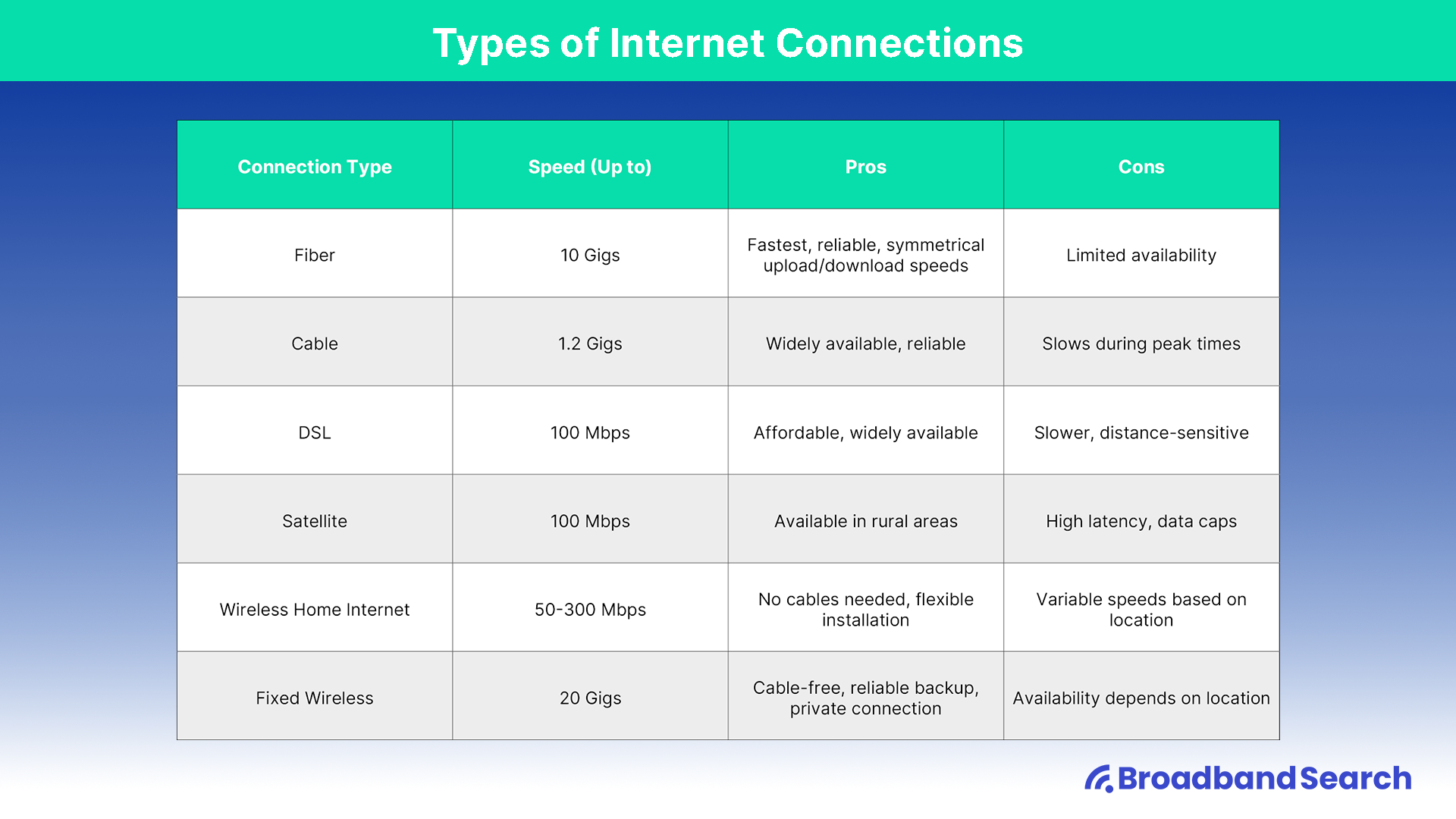
Fiber 250 to 1,000 250 to 1,000 Very fast, strong uploads, great for WFH and creators Not available everywhere
Cable 10 to 500 5 to 50 Widely available, strong download speeds Upload often much lower than download
DSL 5 to 35 1 to 10 Available in many areas, can be affordable Often slower, performance drops with distance
Fixed Wireless 10 to 25 1 Can reach rural homes, faster than old DSL in some areas Line-of-sight issues, congestion possible
Satellite (GEO) 25 3 Works in remote areas Higher latency, weather impacts
Satellite (LEO) 25 to 220 5 to 20 Better latency than old satellite, broad coverage Can vary by congestion and location
Fast fiber internet leads in performance and reliability, while fast cable internet offers a solid middle ground with better availability. Enter your ZIP code in our search tool to see what’s available at your address.
Mbps vs Gbps: Do You Really Need Gigabit Internet?Not everyone needs gigabit internet, but large households with multiple users and numerous devices, smart home technology, competitive gamers, and content creators certainly benefit from its performance.
What Is the Difference Between Mbps and Gbps?Mbps (megabits per second) and Gbps (gigabits per second) measure the same thing at different scales, with 1 Gbps equaling 1,000 Mbps. Gigabit internet can make big downloads feel instant, reduce slowdowns with many devices, and give you more headroom for the future.
Is gigabit internet worth it?
It often is if you have:
A large household with many simultaneous users
Multiple 4K streams running daily
Remote workers who upload large files
Content creators (video, design, photography)
Heavy cloud backups across many devices
It’s overkill if:
You have 1 to 2 people mostly browsing and streaming in HD
Your “pain point” is Wi-Fi coverage, not plan speed
You rarely notice slowdowns on 200 to 300 Mbps
If you rarely max out a 200 to 300 Mbps connection during your busiest internet use, you probably don't need gigabit yet. Test your actual usage first before paying for speeds you won't use.
How to Choose the Right Internet Speed for Your HomeFollow this step-by-step checklist for how to choose the right internet speed without overbuying.
Count regular users and devices (phones, TVs, consoles, laptops, cameras, smart devices).
List your top activities (4K streaming, gaming, video calls, large uploads, cloud backups).
Match your home to a row in the speed comparison chart above.
Check which providers and connection types are available (fiber, cable, DSL, satellite, 5G home internet).
Compare your current plan to the recommended range for your household.
Choose a plan that covers today plus near-future growth, especially if your household is adding devices.
This approach usually gets you to the best internet speed for home without paying for speed you won’t use.
How to Test Your Internet Speed and When to UpgradeTesting your current speed can help you identify problems and make an informed decision if you’re thinking about switching providers or upgrading your plan.
How to test your internet connection:
When to upgrade:
How to Troubleshoot Slow Internet (Before You Switch Plans)Before you pay for more internet speed, make sure your setup isn’t the bottleneck.
These quick fixes can solve a surprising number of issues:
Many problems actually stem from router issues, Wi-Fi congestion, or poor placement rather than the speed coming from your provider. These fixes cost nothing but a little time and might save you from an unnecessary plan upgrade.
Recommended Internet Speeds for Streaming, Gaming, and Video CallsUse this table to sanity-check your plan or speed test results against the activities you care about most.
Internet Speed Recommendations by Activity Activity Minimum Speed (Mbps) Recommended Speed (Mbps) NotesHD streaming (one device) 3 to 5 10 to 25 Netflix recommends 3 Mbps (720p) and 5 Mbps (1080p). Netflix Help Center
4K streaming (one device) 15 25+ Netflix recommends 15 Mbps for 4K. Netflix Help Center
Online gaming 10 to 25 25 to 100 Gaming cares more about latency than raw Mbps.
Video calls (1:1 HD) 1 to 2 3 to 5+ Zoom lists ~1.2 Mbps for 720p and higher for 1080p. Zoom
Video calls (1080p) 3 to 4 5 to 10+ Zoom notes 1080p needs about 3.8 Mbps up and 3.0 Mbps down. Zoom
Group video meetings 3+ 10+ More participants can push bandwidth and CPU requirements. Google Meet notes inbound needs rise with participants. Google Help
Cloud backups and large uploads 10+ upload 20 to 50+ upload Upload speed is the limiting factor for backup and file sending.
If your house does multiple 4K video streams plus video calls at the same time, jump to 500 Mbps. The extra speed and bandwidth are enough for all users to have stable connections.
How Much Internet Speed Do I Need to Work from Home?For working from home, you’ll need more consistency and upload speed than download speed.
Solo remote worker: 25–100 Mbps handles video calls, cloud applications, and email comfortably
Multiple remote workers or students in one home: 100–200 Mbps or more prevents congestion during simultaneous video calls
Heavy cloud tools, large file transfers, or video editing: 200–500 Mbps or more, plus good upload speeds (20+ Mbps minimum)
You can also optimize your work-from-home setup by:
Using a wired Ethernet connection for your work computer whenever possible
Prioritizing work devices on your network using router QoS (Quality of Service) settings if available (check the manual or manufacturer’s website for instructions)
Considering a Wi-Fi 6 router or mesh system for better signal strength throughout your home
If you do lots of video calls, also pay attention to latency. For example, Google Meet recommends latency under 50 ms for HD quality video calls.
Putting It All Together: How to Know If Your Internet Is Fast EnoughAt the end of the day, fast internet is less about blazing fast download speed and more about having stable internet that suits your needs. For most homes, 100 to 300 Mbps download with 10 to 20 Mbps upload speeds are enough for most online activities. If you have multiple users in your household, work from home, or have a bunch of smart home devices, leveling up to 200 to 500 Mbps might be the right choice.
If you think your current connection is too slow, do the following to determine if it’s your provider or your network:
If your internet hums along when you and everyone else in your house use it the most, then you have fast internet. Or fast enough. If not, then it might be time to upgrade your internet plan or switch providers.
FAQ
What internet speed is considered fast for most households?
For most households, 100 to 300 Mbps download is considered fast, especially when paired with 10 to 20 Mbps upload. If you have multiple users, devices, and 4K streaming, faster tiers (200 to 500 Mbps) can feel noticeably smoother.
What is a good internet speed for streaming movies and TV?
A good streaming setup depends on quality and how many screens you use. Netflix recommends 5 Mbps for 1080p and 15 Mbps for 4K per stream. If you stream on multiple TVs at once, you’ll want extra headroom.
How much internet speed do I need for gaming?
Many games run fine on 25 to 100 Mbps, but latency (ping) matters more than fast download speed. Low ping makes controls feel responsive and reduces lag. As a practical target, many players aim for under 50 ms if possible, and under 100 ms is usually fine for casual play and voice chat. Connection type, Wi-Fi quality, and server distance will also have an affect on your internet speed and gameplay.
What upload speed is considered fast?
For everyday use, 10 Mbps upload is decent. If you work from home, upload lots of photos or video, or do frequent video calls, 20 to 35 Mbps+ upload speed should suffice. Consider fiber internet if it’s available in your area. With it you get symmetrical speeds, meaning the download and upload speeds are the same.
How do I know if I’m getting the internet speed I pay for?
Run multiple internet speed tests throughout the day, ideally on a wired connection. Compare your download and upload results to your plan’s advertised speeds. If your speeds are consistently lower, troubleshoot Wi-Fi and equipment first, then contact your provider if the issue persists.
Is gigabit internet worth it for my home?
Gigabit (1,000 Mbps) is worth it if you have a large household, many people using the internet at the same time, upload large files, or lots of cloud syncing. But it might be too much for only one or two people.