欧博官网Agriculture Sector Emissions
Total U.S. Greenhouse Gas Emissions by Economic Sector in 2022
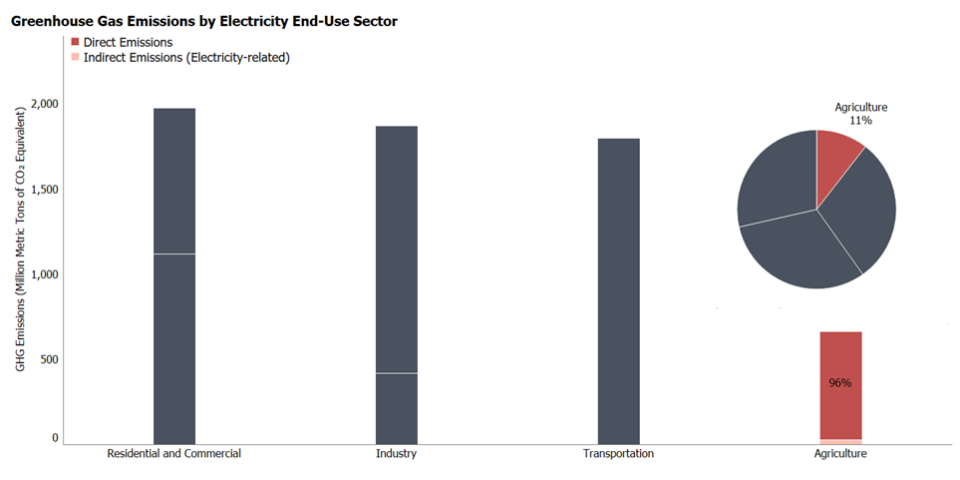
Total Emissions in 2022 = 6,343 . Percentages may not add up to 100% due to independent rounding. Land Use, Land-Use Change, and Forestry in the United States is a net sink and offsets 12% of these greenhouse gas emissions. This net sink is not shown in the above diagram. All emission estimates are sourced from the Inventory of U.S. Greenhouse Gas Emissions and Sinks: 1990–2022.
On this page:
Sources of Agriculture Sector EmissionsAgricultural activities — crop and livestock production — contribute to emissions in a variety of ways:
More information about emissions from agriculture can be found in the agriculture chapter in the Inventory of U.S. Greenhouse Gas Emissions and Sinks.
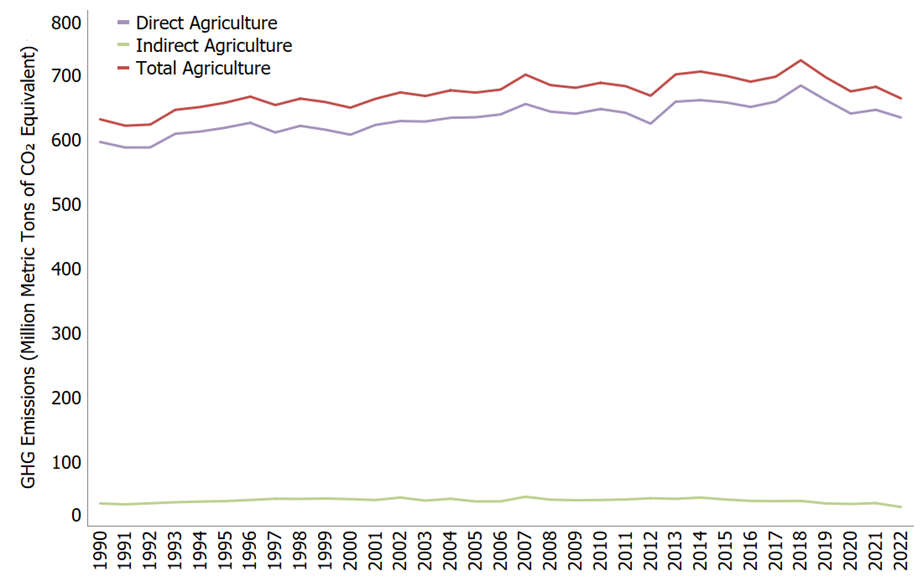
Agriculture Sector Emissions TrendsIn 2022, direct greenhouse gas emissions from the agriculture sector accounted for 9.4% of total U.S. greenhouse gas emissions.
Greenhouse gas emissions from agriculture have increased by 8% since 1990. Agricultural soil management activities, such as application of synthetic and organic fertilizers, deposition of livestock manure, and growing nitrogen fixing plants, were the largest contributors to U.S. N2O emissions in 2022, accounting for 75% of total N2O emissions. Emissions from other agricultural sources have generally remained flat or changed by a relatively small amount since 1990.
Greenhouse Gas Emissions from Agriculture, 1990-2022
The table shown below provides examples of opportunities to reduce emissions from agriculture. For a more comprehensive list of options and a detailed assessment of how each option affects different gases, see Chapter 7 of the Contribution of Working Group III to the Sixth Assessment Report of the Intergovernmental Panel on Climate Change.
Examples of Reduction Opportunities for the Agriculture Sector Type How Emissions Are Reduced ExamplesLand and Crop Management Adjusting the methods for managing land and growing crops.
Fertilizing crops with the appropriate amount of nitrogen required for optimal crop production, since over-application of nitrogen can lead to higher nitrous oxide emissions without enhancing crop production.
Draining water from wetland rice soils during the growing season to reduce methane emissions.
Livestock Management Adjusting feeding practices and other management methods to reduce the amount of methane resulting from enteric fermentation.
Improving pasture quality to increase animal productivity, which can reduce the amount of methane emitted per unit of animal product. Also, increased productivity in livestock can be introduced through improved breeding practices.
Manure Management
Controlling the way in which manure decomposes to reduce nitrous oxide and methane emissions.
Capturing methane from manure decomposition to produce renewable energy.
An Explanation of Units A million metric tons of CO2: What does that mean?
A million metric tons equals about 2.2 billion pounds, or 1 trillion grams. For comparison, a small car is likely to weigh a little more than 1 metric ton. Thus, a million metric tons are roughly the same mass as 1 million small cars.
The U.S. GHG Inventory uses metric units for consistency and comparability with other countries. For reference, a metric ton is slightly more (approximately 10%) than a U.S. "short" ton.
Greenhouse gas emissions are often measured in carbon dioxide (CO2) equivalent. To convert emissions of a gas into CO2 equivalent, its emissions are multiplied by the gas's Global Warming Potential (GWP). The GWP takes into account the fact that many gases are more effective at warming Earth than CO2, per unit mass.
The GWP values appearing in the Overview of Greenhouse Gases and Sources of Greenhouse Gas web pages reflect the values used in the U.S. GHG Inventory, which are drawn from the IPCC's Fifth Assessment Report (AR5). For further discussion of GWPs and an estimate of greenhouse gas emissions using updated GWPs, see Annex 6 of the U.S. GHG Inventory and the IPCC's discussion on GWPs (pdf) (13.9 MB).