欧博娱乐The Tactile System: How it Works, Signs of Pro
What’s inside this article: A look at how the tactile system, aka our sense of touch, works. Includes signs of sensory processing challenges, which affect up to 95% of children with autism, and a list of useful strategies and activities to help kids with tactile processing sensitivities.
Your sense of touch is called the tactile system. It’s how we feel all touch sensations, including vibrations, temperature, textures, and pain.
We have receptors in our skin all over our bodies that send signals to our brains. These signals let us know when we’ve touched something and what we’ve touched.
This post is part of a 10 part series on the sensory systems. Each part will contain a table of contents to help you easily navigate through the entire series.
Table of Contents:Introduction – The Sensory Spectrum
The Tactile System
The Auditory System
The Visual System
Proprioception
Vestibular System
Interoception
The Olfactory System
The Oral-Motor System
Bilateral Coordination
How Does The Tactile System Work?There are six different types of receptors in our skin that allow us to feel and perceive touch. These receptors are the main sensory cells in the tactile system.
A sensation occurs when neural impulses from these receptors reach a part of the brain called the cerebral cortex. The cerebral cortex interprets the sensations and sends a signal back to the receptors, this is the perception of the sensation – what we feel.
Types of Tactile ReceptorsFirst of all, the skin is composed of layers.
The epidermis is the skin’s outer layer. It provides a protective barrier for the dermis. The dermis is a thick layer of tissue below the epidermis that forms the “true skin.” It contains blood, capillaries, nerves, sweat glands, and hair follicles. It’s also where all of the different tactile receptors are located.
As you can see in the diagram, each tactile receptor is attached to the nerve cell. That’s because these receptors are specialized types of nerve endings.
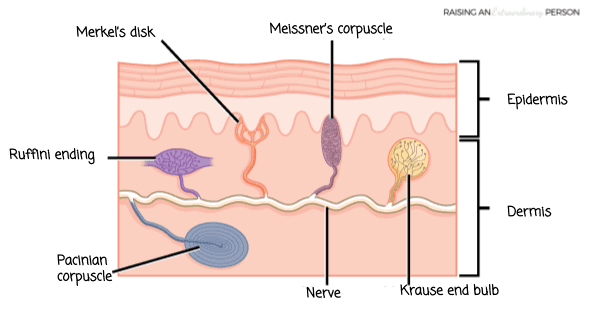
Meissner’s Corpuscle – These sensory receptors are nearest the skin’s surface. When these corpuscles are deformed by pressure, they send neural signals to the brain. These receptors perceive fine touch, pressure, and vibrations.
Merkel’s Disk – These receptors are nerve endings located at the bottom of the epidermis and in hair follicles. They send signals to the brain that decode the features of touched objects, such as their texture and temperature. They are extremely sensitive to pain.
Ruffini Ending – These receptors perceive any stretching of the skin. They also detect temperature and pressure.
Pacinian Corpuscle – Detects deep pressure sensations. These receptors play a large role in proprioception.
Krause End Bulb – These are sensitive to the cold. In fact, they only activate when touching something with a temperature below 20 degrees.
Free Nerve Endings – (Not pictured) are non-specialized nerve cell endings. They respond to all stimuli – pressure, temperature, pain, texture, etc.
When a child’s tactile system is working well, they can filter out irrelevant tactile input and respond to touch sensations appropriately.
They should show a curiosity for touching and interacting with their environment, but they should not be preoccupied with touch or fearful of touch.
Sensory Processing Problems Related to the Tactile SystemThe list below outlines some common signs that your child may be struggling with tactile processing issues.
Discrimination and perception issues occur when the brain is struggling to interpret and give meaning to sensory input.
Modulation IssuesThis occurs when the brain over- or under-responds to sensory input.
Because different receptors detect and perceive different types of touch – it’s possible to be both under-responsive to certain types of touch and over-responsive to others.
Over-responsive (Tactile Defensiveness/Avoidance)Fearful or strong dislike of large crowds.
Dislikes hair brushing, washing, and drying, and cutting
Extremely ticklish
Walks on tiptoes
Refuses to walk in bare feet
Responds with emotional intensity to light touch. For example, acting as if a gentle pat on the back is painful.
Completely avoids certain sensations – like putting feet in the sand, or touching finger paint.
Upset by the feelings of tags or seams in clothing. May even refuse to wear certain clothing items of types of fabric.
Picky Eater.
Doesn’t enjoy messy play – sand, mud, slime, foam, etc.
Acts distressed when getting fingernails and toenails cut.
Finds cold or warm weather extremely uncomfortable
Under-Responsiveness (Tactile Input Seeking)Constantly touches everything, as if they can’t resist.
Enjoys certain strong flavors – salty, sweet, sour, etc.
High pain tolerance, doesn’t notice when they get hurt
Being rough with others may hurt them without meaning to. Others may say they are “unaware of their own strength.”
Doesn’t notice when touched lightly by others
Not aware when their face is dirty or nose is running
May engage in self-injurious behavior such as biting, pinching, hitting, or headbanging
May not notice or seem affected by the temperature. For example, could go outside without a jacket and not complain of the cold. Likewise, they may wear long sleeves in the summer and not complain about the heat.
Strategies for Managing Tactile Processing ChallengesThe type of strategies that will help your child will depend on what kind of challenges they’re experiencing.
As mentioned, because different receptors detect different sensations, it’s possible your child will seem defensive to some sensations and seek others.

Create opportunities for messy play with sensory bins, water tables, sandboxes, etc.
Use touch-and-feel books, tactile fidget toys, slimes, putty, etc.
Offer opportunities to experience many different textures. For example, at the park, get your child to feel the bark on a tree, the grass, the rocks, etc, and talk about those experiences.
Play that provides tactile input to the whole body – ball pits, swimming, playing in sprinklers etc.
Include touch when learning new concepts – for example, getting them to feel differently shaped blocks while teaching shapes or getting them to draw the alphabet with their finger in the sand.
For Discrimination and Perception IssuesMix small toys in sensory bins filled with sand, flour, rice, or water beads and encourage your child to feel around to find them.
Play guessing games where your child closes their eyes and tries to guess what object you give them based on how it feels.
Draw shapes or letters with your finger on your child’s back and get them to guess what you drew.
Touch matching games – like playing memory but with different textures instead of photos
Mystery Objects – Take 5 or 6 pairs of matching objects and put them in a bag. Have your child pull out one object and then reach the bag to find its pair, relying only on sight.
The tactile system, with its intricate network of receptors, is fundamental for sensory perception, influencing how we interact with our environment.
Recognizing and addressing tactile processing challenges, such as sensory defensiveness or under-responsiveness, can significantly improve a child’s interaction with their surroundings.
Tailored strategies, including sensory activities and environmental adaptations, can effectively support children in managing these challenges.