欧博abgWhat is a dinosaur?
This is a human-written story voiced by AI. Got feedback? Take our survey. (See our AI policy .)
Visit your local natural history museum gift shop and you’ll probably find a container of dinosaur toys for sale. Dump out its contents, though, and you’ll likely find some imposters, says Nathan Smith. He should know. He’s director and curator of the Dinosaur Institute in California. It’s part of the Natural History Museum of Los Angeles. Winged pterosaurs are a common fraud. So is the sail-backed carnivore, Dimetrodon.
Classroom Resources for This Article
Readability Score: 8.4
Science News Learning Educator GuidesThe word “dinosaur” isn’t a catch-all term for just any scaly, prehistoric giant. “There’s kind of a misconception that any big extinct thing was a dinosaur,” Smith says.
In fact, dinos are a specific group of reptiles. They have been around continuously for more than 200 million years. They include everything that’s descended from the earliest common ancestor of avian (bird) and non-avian dinosaurs, Smith explains.
Non-avian dinosaurs include such iconic beasts as Triceratops and Tyrannosaurus rex. Emerging in the Triassic, non-avian dinosaurs dominated the planet during the Mesozoic Era. This later era — also known as the Age of Dinosaurs — lasted until the close of the Cretaceous Period some 66 million years ago. Scientists suspect that’s when an asteroid wiped out about 80 percent of all animals.
Not all dinosaurs vanished after this impact, though. Some birds survived. They evolved into the more than 11,000 species of dinosaurs that roam Earth today.
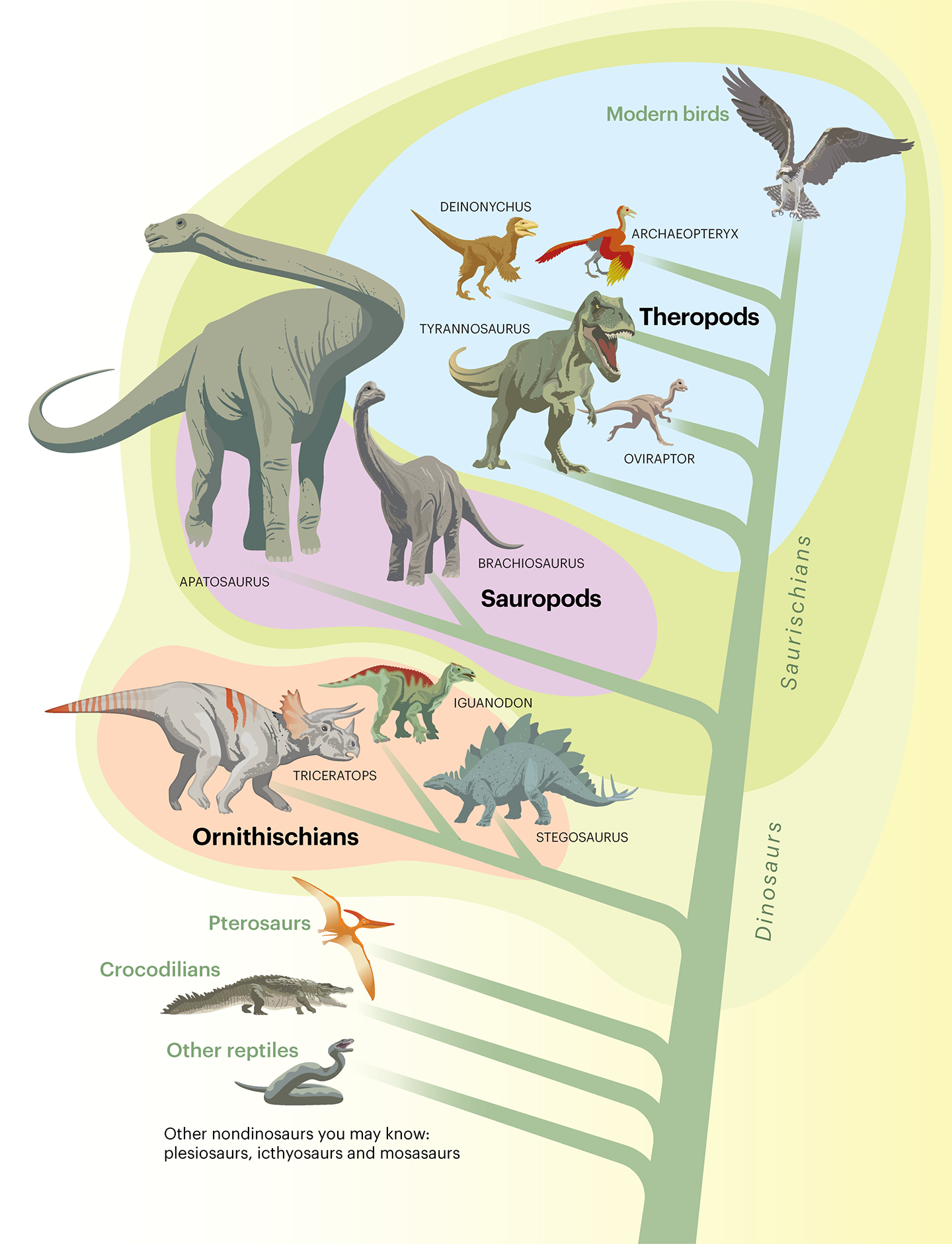
Birds first arose some 160 million years ago. They descended from small, meat-eating dinosaurs similar to Velociraptor (of Jurassic Park fame).
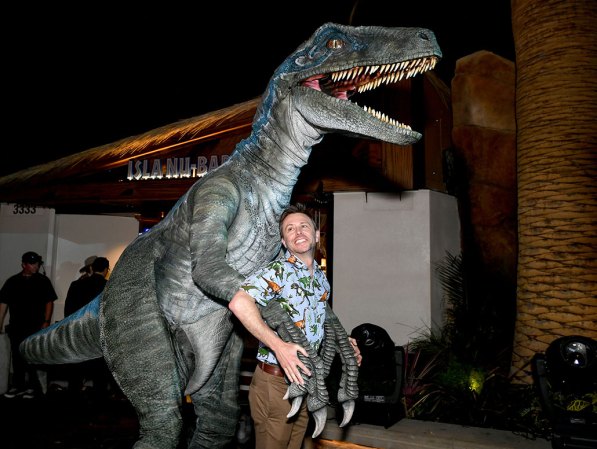
So if birds descended from dinosaurs, does that make them reptiles? Evolutionarily speaking, yes.
Traditionally, animals have been classified based on their physical features alone. Under this system, birds — warm-blooded and covered in feathers — were separated from scaly, cold-blooded reptiles. Today, most researchers instead organize living beings by their evolutionary relationships.
And new findings are offering better insights into the origin of birds. This has allowed researchers to trace bird ancestry back to their ancient dino ancestors.
Some hallmark features of today’s birds — such as feathers — came from non-avian dinosaurs. Meanwhile, certain traits set them apart from other reptiles. Consider the pygostyles (PY-go-stiles). These fused backbones support a bird’s tail feathers.
“Birds are a subgroup of dinosaurs,” says Smith. “All of those are then a subgroup of reptiles. Birds are dinosaurs in the same way that bats are mammals.”
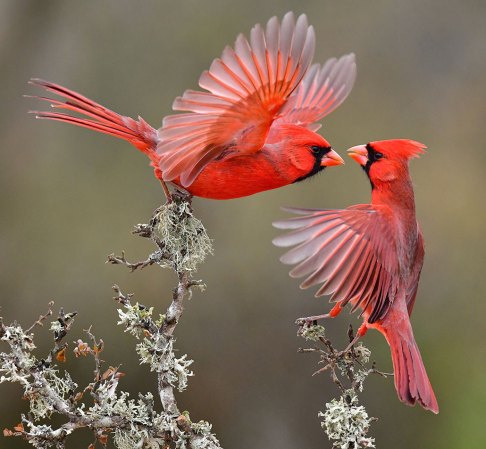
In the Jurassic Period, most dinosaurs couldn’t fly (though some related reptiles and early birds did). But today, nearly all the surviving dinosaurs — birds such as these northern cardinals — are as at home in the skies as they are on land.
Who isn’t a dino?Understanding how dinosaurs evolved can help weed out the imposters.
Explainer: The age of dinosaursFor instance, pterosaurs are close relatives to dinosaurs. But the two groups split from one another during the Triassic, more than 235 million years ago. Meanwhile, marine reptiles such as mosasaurs, plesiosaurs and ichthyosaurs aren’t closely related to dinosaurs, says Smith. Indeed, all true dinosaurs lived on land. But some, such as Spinosaurus, may have stalked ancient wetlands and beaches.
And Dimetrodon? It wasn’t a reptile at all. This distant relative of the ancestor of mammals lived about 50 million years before the first dinosaurs.
Those scaly pterodactyls sailing through Jurassic skies may look like dinos — but they aren’t. This short video explains what sets the flying reptiles apart from ancient and modern dinos. Joined at the hipOver tens of millions of years, dinosaurs evolved a dizzying array of sizes, shapes and adaptations. The most classic dino features have to do with how they moved, Smith explains.
“These are animals that are bringing their limbs underneath their body,” he says. “That involves changes in the hip bones and the leg bones.”
The top of their thigh bones — or femurs — turn inward to attach to the hip socket. Their pelvis features a unique hole where the femur attaches. Other prehistoric reptiles didn’t have this opening in their hip.
These traits gave dinosaurs an upright stance, with their legs placed under their bodies. It allowed them to spend less energy while moving. Even today’s lizards, turtles and crocodiles (the closest living relative to dinosaurs) all stand with a more sprawling posture.
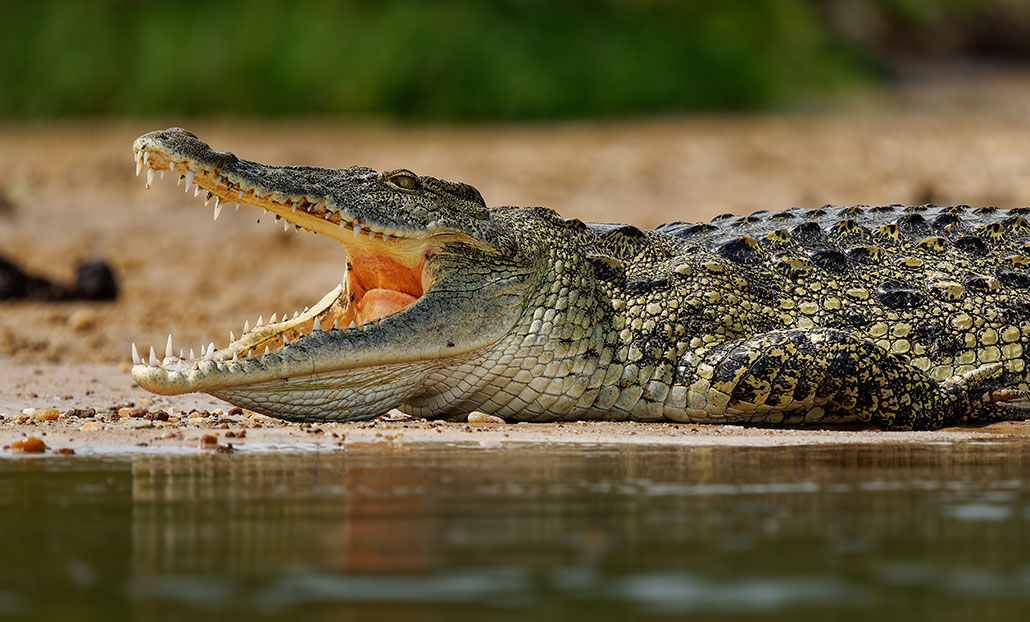
This hip arrangement would have helped ancient dinosaurs occupy different niches, says ReBecca Hunt-Foster. It allowed smaller dinosaurs to make a speedy getaway from predators. Hunt-Foster, a vertebrate paleontologist, works at Dinosaur National Monument in Jensen, Utah.
In dinosaurs too large to flee from danger, that unique hip structure also helped support their weight. Some, such as the armored ankylosaurs and spike-wielding stegosaurs, would have been weighed down by those defenses.
This hip adaptation even helped support the sheer bulk of the titanosaurs — the largest land animals to ever live. Some may have reached a staggering 37 meters (120 feet) and tipped the scales at 70 metric tons. (One word of caution: So few bones from such behemoths have been found that calculating their true adult size remains fairly iffy).
Hippie trait may explain dino diversityHip fossils don’t just help researchers determine if an animal was a dinosaur. They also help explain how dinos diverged so greatly.
Dinos belong to two major groups based on the shape of their lower hip bone, or pubis.
In Saurischian (Soar-IH-shee-un) — or “lizard-hipped” — dinosaurs this bone juts forward. Saurischians can be divided into two smaller groups: the meat-eating theropods (think Tyrannosaurus rex and Deinonychus) and long-necked sauropods such as Brachiosaurus and Diplodocus.
The famous frilled dino Triceratops and herd-dwelling duck-billed hadrosaurs, though, were Ornithischians. That term means “bird-hipped.” It came from 19th century scientists who noticed that the reversed pubis in these dinosaurs resembled those bones in birds.
However, Smith notes, “That name has always been problematic.” Why? Birds actually evolved from “lizard-hipped” theropods. Birds would independently evolve a backward-facing pubis later. For Ornithischians, that reversed hip bone may have helped create more gut space. This would have let them digest massive quantities of plants.
Dinosaurs are still alive. Today, we call them birdsIn the late 1800s, researchers proposed that these two types of hips must have come from different ancestors. But Smith says we now know all dinos evolved from one group of small, speedy dinosaurs that lived during the Triassic, about 230 million years ago.
Scientists coined the term “dinosaur” in 1842. Back then, only a few species were known. Researchers assumed these ancient reptiles were clumsy, sluggish giants. Since then, scientists have turned up about 1,000 non-avian species of this group. And some scientists suspect these represent only a fraction of all that ever lived. New species continue to be named each year.
Their fossil remains have turned up on every continent. Understanding them is helping researchers better understand how these animals dominated most ecosystems for roughly 165 million years.
It’s also confirmed that birds are, in fact, dinosaurs — the only surviving ones. Like their ancestors, these living dinos are an evolutionary success. “Birds occupy every single niche on every single continent,” says Hunt-Foster. “And they’ve just kind of continued that from the Mesozoic.”
This short video shows where today’s birds branched off the family tree from their reptilian ancestors.
Related Stories

Earth Not one, but two asteroids might have ended the age of dinosaurs
By Nikk OgasaSeptember 26, 2022
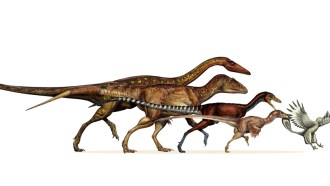
Fossils Dinos ‘quickly’ shrunk into birds
By Stephen OrnesAugust 11, 2014
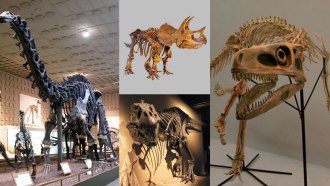
Animals Scientists are rethinking the dinosaur family tree
By Rachel EhrenbergMay 1, 2017
Lesson Plan
Power Words More About Power Words
adaptation: (in biology) The development of new programs, processes, policies and structures to make communities and their inhabitants better able to head off — or at least withstand — the dangerous impacts of a warming climate. Those impacts may include drought, flooding, wildfires, extreme heat and extreme storms.
ancestor: A predecessor. It could be a family forebear, such as a parent, grandparent or great-great-great grandparent. Or it could be a species, genus, family or other order of organisms from which some later one evolved. For instance, ancient dinosaurs are the ancestors of today's birds. (antonym: descendant)
array: A broad and organized group of objects. Sometimes they are instruments placed in a systematic fashion to collect information in a coordinated way. Other times, an array can refer to things that are laid out or displayed in a way that can make a broad range of related things, such as colors, visible at once. The term can even apply to a range of options or choices.
asteroid: A rocky object in orbit around the sun. Most asteroids orbit in a region that falls between the orbits of Mars and Jupiter. Astronomers refer to this region as the asteroid belt.
avian: Of or relating to birds.
bat: A type of winged mammal comprising more than 1,400 separate species — or one in every four known species of mammal. (in sports) The usually wooden piece of athletic equipment that a player uses to forcefully swat at a ball. (v.) Or the act of swinging a machine-tooled stick or flat bat with hopes of hitting a ball.
birds: Warm-blooded animals with wings that first showed up during the time of the dinosaurs. Birds are jacketed in feathers and produce young from the eggs they deposit in some sort of nest. Most birds fly, but throughout history there have been the occasional species that don’t.
Brachiosaurus: With very long necks and short tails, these enormous dinosaurs have been likened to huge giraffes. Unlike most dinos, their front legs were longer than their hind limbs. Their body shape would have allowed these mammoth creatures to reach their heads as much as 12 meters (39 feet) above the ground — high enough to browse the leaves of tall trees. Big adults could have weighed nearly 80 metric tons and reached a length of nearly 25 meters (82 feet).
carnivore: An animal that either exclusively or primarily eats other animals.
cold-blooded: Adjective for an animal whose body temperature varies with that of its environment.
common ancestor: Also known as shared ancestor. It's an ancestor that two or more descendants have in common. Two siblings share a parent as a common ancestor. This also applies on the level of species and groups of organisms. Two or more species can share a common ancestor at the genus level. Two or more genera can share a common ancestor at the family level, and so on. Tigers and lions have a common ancestor, as do humans and Neandertals.
continent: (in geology) The huge land masses that sit upon tectonic plates. In modern times, there are six established geologic continents: North America, South America, Eurasia, Africa, Australia and Antarctica. In 2017, scientists also made the case for yet another: Zealandia.
Cretaceous: A geologic time period that included the end of the Age of Dinosaurs. It ran from roughly 145.5 million years ago until 65.5 million years ago.
defense: (in biology) A natural protective action taken or chemical response that occurs when a species confronts predators or agents that might harm it. (adj. defensive)
descendant: A blood relative of a person who lived during a previous time.
digest: (noun: digestion) To break down food into simple compounds that the body can absorb and use for growth. Some sewage-treatment plants harness microbes to digest — or degrade — wastes so that the breakdown products can be recycled for use elsewhere in the environment.
Dimetrodon: A reptile that lived around 280 million years ago, well before dinosaurs. It’s body was shaped somewhat like a small crocodile, but with a large scale flaring up from its back. This animal was a meat-eater and probably dined primarily on aquatic animals, from sharks to a meter-long amphibian known as Dipocaulus.
dinosaur: A term that means “terrible lizard”. These reptiles emerged around 243 million years ago. All descended from egg-laying reptiles known as archosaurs. Their descendants eventually split into two lines. For many decades, they have been distinguished by their hips. The lizard-hipped line are believed to have led to the saurischians, such as two-footed theropods like T. rex and the lumbering four-footed Apatosaurus. A second line of so-called bird-hipped, or ornithischian dinosaurs, appears to have led to a widely differing group of animals that included the stegosaurs and duckbilled dinosaurs. Many large dinosaurs died out around 66 million years ago. But some saurischians lived on. They are now the birds we see today (and who have now evolved that so-called “bird-hipped” pelvis).
diversity: A broad spectrum of similar items, ideas or people. In a social context, it may refer to a diversity of experiences and cultural backgrounds. (in biology) A range of different life forms.
ecosystem: A group of interacting living organisms — including microorganisms, plants and animals — and their physical environment within a particular climate. Examples include tropical reefs, rainforests, alpine meadows and polar tundra. The term can also be applied to elements that make up some an artificial environment, such as a company, classroom or the internet.
evolution: (v. to evolve) A process by which species undergo changes over time, usually through genetic variation and natural selection. These changes usually result in a new type of organism better suited for its environment than the earlier type. The newer type is not necessarily more “advanced,” just better adapted to the particular conditions in which it developed. Or the term can refer to changes that occur as some natural progression within the non-living world (such as computer chips evolving to smaller devices which operate at an ever faster speed).
evolutionary: An adjective that refers to changes that occur within a species over time as it adapts to its environment. Such evolutionary changes usually reflect genetic variation and natural selection, which leave a new type of organism better suited for its environment than its ancestors. The newer type is not necessarily more “advanced,” just better adapted to the conditions in which it developed.
femur: In humans, the large bone in the upper leg. It is commonly known as the thighbone. In tetrapods (creatures with four limbs), it’s the large bone in the upper hind limbs.
fossil: Any preserved remains or traces of ancient life. There are many different types of fossils: The bones and other body parts of dinosaurs are called “body fossils.” Things like footprints are called “trace fossils.” Even specimens of dinosaur poop are fossils. The process of forming fossils is called fossilization.
fraud: To cheat; or the resulting effects of something done by cheating. Or to make a mistake and intentionally cover up the error.
fused: An adjective for something that has features that have been joined or merged together into a single thing. (in electrical devices) An adjective for devices that contain parts known as fuses.
geologic: An adjective that refers to things that are related to Earth’s physical structure and substance, its history and the processes that act on it. People who work in this field are known as geologists.
gut: An informal term for the gastrointestinal tract, especially the intestines.
hadrosaur: A duck-billed, plant-eating dinosaur that lived during the late Cretaceous Era.
ichthyosaur: A type of giant marine reptile that looks similar to a porpoise. Its name means “fish lizard.” It was not related to fish or marine mammals, however. And although not a dinosaur, it lived at the same time as dinosaurs.
insight: The ability to gain an accurate and deep understanding of a situation just by thinking about it, instead of working out a solution through experimentation.
Jurassic: A period lasting from about 200 million to 145.5 million years ago, it’s the middle period of the Mesozoic Era. This was a time when dinosaurs were the dominant form of life on land.
kin: Family or relatives (sometimes even distant ones).
lizard: A type of reptile that typically walks on four legs, has a scaly body and a long tapering tail. Unlike most reptiles, lizards also typically have movable eyelids. Examples of lizards include the tuatara, chameleons, Komodo dragon, and Gila monster.
mammal: An animal distinguished by possessing hair or fur, the secretion of milk by females for the feeding of their young, and (typically) the bearing of live young. They also are warm-blooded (or endothermic).
marine: Having to do with the ocean world or environment.
Mesozoic: An era in geologic history that contained three related periods which became renowned for their large reptiles: the Triassic (which spanned from 251 to 199.6 million years ago), the Jurassic (which spanned from 199.6 to 145.5 million years ago), and the Cretaceous (which spanned from 145.5 to 65.5 million years ago).
mosasaur: A type of extinct marine reptile that lived at the same time as dinosaurs.
niche: A small or narrow pocket that sets something apart, or perhaps offers a region of protection. (In ecology) The term for the role that an organism plays in its community.
non-avian: An adjective that means not having to do with birds. It’s frequently used to refer to those dinosaurs that aren’t birds.
Ornithischian: One of the two major groups of dinosaurs, the other being Saurischian. Ornithischian hip bones were arranged like those in today’s surviving dinosaurs — birds
paleontologist: A scientist who specializes in studying fossils, the remains of ancient organisms.
pelvis: Bones that make up the hips, connecting the lower spine to leg bones. There is a gap in the middle of the pelvis that is larger in females than in males and can be used to tell the sexes apart.
physical: (adj.) A term for things that exist in the real world, as opposed to in memories or the imagination. It can also refer to properties of materials that are due to their size and non-chemical interactions (such as when one block slams with force into another). (in biology and medicine) The term can refer to the body, as in a physical exam or physical activity.
plesiosaur: A type of extinct marine reptile that lived at the same time as dinosaurs and is noted for having a very long neck.
predator: (adjective: predatory) A creature that preys on other animals for most or all of its food.
prehistoric: An adjective for something that happened tens of thousands to millions of years ago, periods before people began deliberately recording events.
pterosaur: Any of various extinct flying reptiles of the order Pterosauria. These animals lived 245 million years ago to 65 million years ago. Although not true dinosaurs, they lived during the reign of dinosaurs. Among members of this order were the pterodactyls of the Jurassic and Cretaceous periods, which were characterized by wings consisting of a flap of skin supported by the very long fourth digit on each forelimb.
pubic bone or pubis: The term for either of the two bones that make up the sides of the pelvis.
pygostyle: The bony plate that forms the back end of the backbone in most birds. It is made from a series of vertebrae that have merged into one solid bony structure.
reptile: Vertebrate animals belonging to a group known as Reptilia. Most reptiles have skin that is covered with scales or horny plates. Snakes, turtles, lizards and alligators are all reptiles. Once considered their own separate group, birds now belong to this order. With the exception of modern birds, most reptiles are cold-blooded (or ectothermic).
Reptilia: A taxonomic of animals that includes reptiles (such as snakes, turtles, alligators and ancient dinosaurs). Most researchers now agree that birds also belong to this order.
Saurischians: One of the two major groups of dinosaurs (the other being the ornithischians). Saurischian hip bones are described as “lizard”-like. That's because their bones point forward the way they do in modern lizards. Ironically, modern birds are saurischians.
sauropod: A very large, four-legged, plant-eating dinosaur with a long neck and tail, small head and massive limbs.
species: A group of similar organisms capable of producing offspring that can survive and reproduce.
stegosaurs: Plant-eating dinosaurs that had large, protective plates or spikes on their backs and tails. The best known: stegosaurus, a 6 meter (20-foot) long creature from the late Jurassic that lumbered around the Earth some 150 million years ago.
system: A network of parts that together work to achieve some function. For instance, the blood, vessels and heart are primary components of the human body's circulatory system. Similarly, trains, platforms, tracks, roadway signals and overpasses are among the potential components of a nation's railway system. System can even be applied to the processes or ideas that are part of some method or ordered set of procedures for getting a task done.
theropod: A usually meat-eating dinosaur that belonged to a group whose members are typically bipedal (walk on two legs). They range from small and delicately built to very large.
titanosaur: A group of dinosaurs with long necks and whiplike tails that ate plants. Named for Titanosaurus, they were noted for their large size.
trait: A characteristic feature of something. (in genetics) A quality or characteristic that can be inherited.
Tyrannosaurus rex: A top-predator dinosaur that roamed Earth during the late Cretaceous period. Adults could be 12 meters (40 feet) long.
unique: Something that is unlike anything else; the only one of its kind.
Velociraptor: A genus of predatory bird-like dinosaurs with a relatively large brain and a long, sharp claw on each foot. Its fossils were first discovered in the 1920s in what is now Mongolia. The roughly meter-tall animal moved on two feet and injured/maimed
prey with one of its sharp talons. Those "killer claws" could also have been used to pin down prey as it was eaten alive, new data suggest — similar to how today's birds of prey use their talons. The Velocirator likely would not have been as daunting as its namesake portrayed in the Jurassic Park movie franchise. Many scientists believe that movie version was actually Deinonychus, a dinosaur twice this dino’s size and known from fossils unearthed in the United States during the 1960s.
vertebrate: The group of animals with a brain, two eyes, and a stiff nerve cord or backbone running down the back. This group includes amphibians, reptiles, birds, mammals and most fish.
warm-blooded: Adjective for animals (chiefly mammals and birds) that maintain a constant body temperature, typically above that of their surroundings. Scientists generally prefer the term endothermic to describe animals that generate heat to control their body’s temperature.
wetland: As the name implies, this is a low-lying area of land either soaked or covered with water much of the year. It hosts plants and animals adapted to live in, on or near water.
A version of this article appears in the May 1, 2025 issue of Science News Explores.
Citations
Journal: M.C. Langer et al. Untangling the dinosaur family tree. Nature. Vol. 551, November 2, 2017, p. E1. doi: 10.1038/nature21700.
Journal: S.J. Nesbitt et al. The earliest bird-line archosaurs and the assembly of the dinosaur body plan. Nature. Vol. 544, April 27, 2017, p. 484. doi: 10.1038/nature22037.
Journal: M.G. Baron et al. A new hypothesis of dinosaur relationships and early dinosaur evolution. Nature. Vol. 543, March 23, 2017, p. 501. doi: 10.1038/nature21700.
Journal: M.C. Langer. The origins of Dinosauria: Much ado about nothing. Palaeontology. Vol. 57, Part 3, 2014, p. 469. doi: 10.1111/pala.12108.
Journal: S.L. Brusatte et al. The origin and early radiation of dinosaurs. Earth-Science Reviews. Vol. 101, July 2010, p. 68. doi: 10.1016/j.earscirev.2010.04.001.

About Aaron Tremper
Aaron Tremper is the editorial assistant for Science News Explores. He has a B.A. in English (with minors in creative writing and film production) from SUNY New Paltz and an M.A. in Journalism from the Craig Newmark Graduate School of Journalism’s Science and Health Reporting program. A former intern at Audubon magazine and Atlanta’s NPR station, WABE 90.1 FM, he has reported a wide range of science stories for radio, print, and digital media. His favorite reporting adventure? Tagging along with researchers studying bottlenose dolphins off of New York City and Long Island, NY.