What parents can expect to pay for daycare in all
If you’re new to Germany and have young children, you may find yourself asking a deceptively simple question: “How much will I have to pay for pre-school childcare?”
The answer is anything but straightforward, because each of Germany’s 16 states sets its own policies on daycare pricing, and municipalities also have considerable leeway to adjust fees based on their own budgets and priorities.
Add to this a range of influencing factors such as family income, number of children, the child’s age, the type of facility and the number of hours booked, and you have a system where almost no two families pay exactly the same amount to have their little ones looked after.
Here's a look at the cost of pre-school (Kita) for parents across all of Germany's 16 federal states to give you an idea of what to expect.
Berlin
Parents in Berlin enjoy one of the most generous childcare systems in Germany.
From roughly the age of one, all children in the city state are entitled to free early childhood education up until they've reached school age, regardless of family income or the number of hours booked.
The only regular cost is a modest monthly contribution for meals, currently set at €23, with optional extras such as sports or language courses capped at €100 per month, according to the PRO Kita portal.
This applies to all hours of care in public facilities, and variation within the city is minimal. Private kindergartens may charge more for additional services, but for most families Berlin offers a straightforward and affordable solution.
READ ALSO: The words you need to understand Germany’s childcare benefits
Mecklenburg-Western Pomerania
The north-eastern state of Mecklenburg-Western Pomerania has followed Berlin’s lead since 2020, offering free childcare for all children from the age of two up to school age.
This covers all types of care – including nursery, kindergarten and after-school provision – for up to ten hours per day depending on the parents’ working situation.
Parents are responsible for meal costs and optional extras, but there is no significant variation within the state. The system is designed to be simple and accessible, making Mecklenburg-Western Pomerania one of the cheapest places for childcare in Germany.
Advertisement
Brandenburg
Brandenburg introduced free childcare for children aged three and above in 2024. Parents pay only for meals and additional services, while social welfare recipients are exempt from all fees.
The move towards free provision for older children has made Brandenburg increasingly attractive for families seeking affordable childcare.
For children under three, fees still apply and can vary by municipality, so it’s important to check local regulations.
Bremen
Since 2019, Bremen has provided free childcare for children aged three and above, covering all types of care, including childminders (Tagesmüttern), which are essentially state-approved, home-based childcare providers.
Parents pay for meals and extras, and fees for younger children depending on local rules. The system is relatively uniform for older children, but families with younger children should expect some variation depending on the municipality.
Lower Saxony
Lower Saxony offers free childcare for children aged three and above in state-supported facilities, covering up to eight hours per day, five days a week.
Additional hours and meals are charged extra, and fees for younger children and private facilities can vary. The state’s approach is generous for families with children over three, but costs can rise for those needing longer hours or private provision.
Advertisement
Hesse
In Hesse, children aged three and above receive six hours of free childcare per day until they start school.
Additional hours, meals and activities are charged, and the fees aren’t always adjusted according to your income in major cities.
Fees for younger children vary, and some municipalities offer further discounts, so it’s worth investigating local options. Hesse’s system is designed to support working families, but costs can add up quickly for those needing extended care.
READ ALSO: The schoolyard terms you need to understand your German-speaking kids
Hamburg
Hamburg provides free childcare for all children for up to five hours per day from birth until school age. If parents require more hours, fees are charged based on income, family size and the age group of the child.
Meals and extras are not included, and fees for extended care can be significant.
The city’s graded system means that costs can vary widely, so families should carefully assess their needs before committing to a particular arrangement.
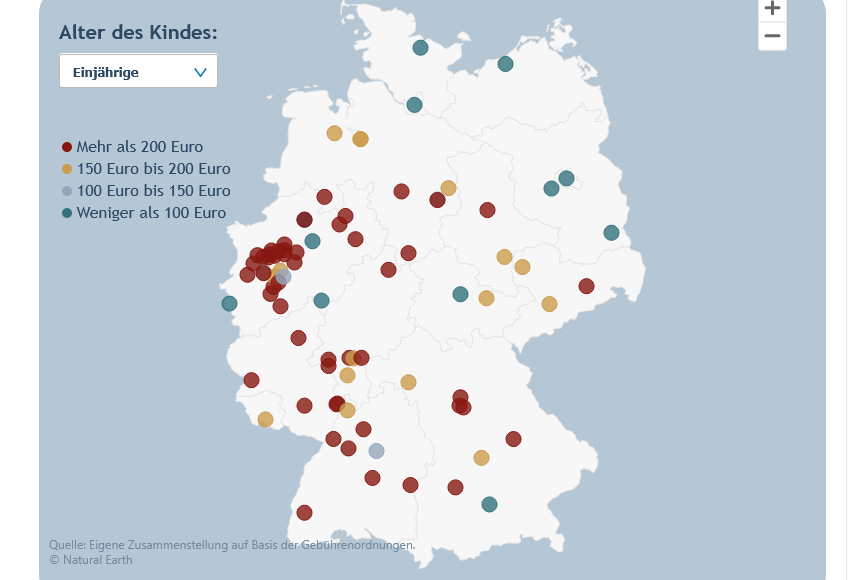
Screenshot of a map produced by the German Economic Institute shows relative pre-school childcare costs in Germany in February 2024. Graphic by IW Köln.
Advertisement
Rhineland-Palatinate
Rhineland-Palatinate has offered free childcare for children aged two and above since 2020.
Parents pay for meals and optional extras, and fees for children under two vary by municipality.
The state’s policy is among the most generous in Germany, but as always, local differences affect the final bill.
READ ALSO: What do children actually learn at school in Germany?
North Rhine-Westphalia
Germany's most populous state, North Rhine-Westphalia (NRW), provides free childcare for the last two years before school entry. So typically from the age of four.
For younger children, however, fees can be high – up to €1,220 per month for full-day care for the children of particularly high earners in certain cities, like Bergisch Gladbach, according to recent data from the German Economic Institute (IW).
Fees vary widely by city and income, and meals and extras are charged separately.
NRW’s system is complex, with significant differences between municipalities, so parents should expect to do some research to find the best option for their family.
Thuringia
Thuringia also offers free childcare for the last two years before school entry.
Fees for younger children depend on the municipality and the number of hours booked. Meals and extras are not included.
The system is designed to ease the financial burden as children approach school age, but costs for younger children can still be substantial.
Advertisement
Saxony-Anhalt
In Saxony-Anhalt, only the oldest child in a family pays fees, with younger siblings attending for free.
Fees for the oldest child vary: care for kids under three averages €194 per month for eight hours per day, while care for kids aged three to five averages around €154 per month.
In some towns, fees can be as low as €45 per month, but extended hours in others can push costs up to around €360, according to reporting by MDR. There is no state-wide fee cap, so local variation is significant.
Saarland
Saarland is gradually reducing fees, with the aim of abolishing them entirely by 2027.
Currently, a full-day place in Saarbrücken costs about €164 per month, plus meals, while a half-day place for children aged three and above costs around €31 per month. Subsidies are available for low-income families, and costs can vary depending on the facility and municipality.
READ ALSO: What having kids at a German kindergarten teaches you about the local culture
Schleswig-Holstein
Schleswig-Holstein has capped fees at a maximum of €288.40 per month for children under three (for eight hours per day) and €226.40 for children over three.
The second child pays half, and the third child is cared for free of charge. Meals and extras are not included, and fees can be lower in some municipalities.
The capped system provides predictability, but parents may still want to check local details and compare options.
Advertisement
Bavaria
In Bavaria, a state subsidy means that kindergartens can be free for children aged three and above in lower cost municipalities, while parents often to have to make an additional contribution in higher cost municipalities.
Nursery fees for under-threes depend on income. Bavaria offers income‑tested “Krippengeld” to reduce costs, generally available to families with a household income up to around €60,000.
The city of Munich has its own model where municipal reductions are available for families with gross incomes up to roughly €80,000.
Meals and extras are charged separately, and costs can vary depending on the municipality and the type of facility.
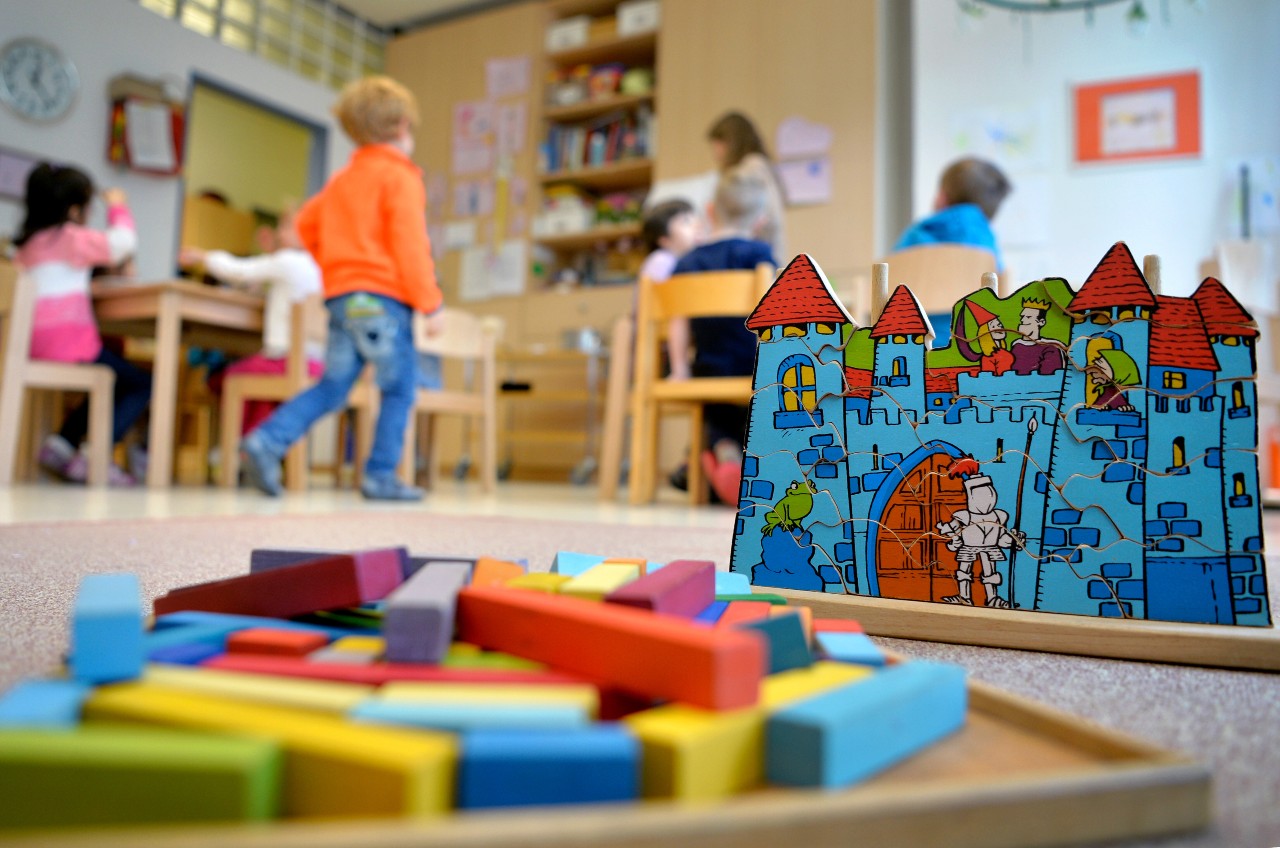
Children play with toys at a kita in Düsseldorf, North Rhine Westphalia. Photo: picture alliance/dpa | Monika Skolimowska
READ ALSO: 'Forget about bilingual Kitas' - Key tips for raising bilingual kids in Germany
Baden-Württemberg
Baden-Württemberg offers free childcare for children aged three and above in some cities, such as Heilbronn. Meanwhile fees for under-threes, and general costs in other cities can be high: up to €614 per month in Reutlingen, €360 in Ulm, and €149 in Stuttgart, for example.
Meals and extras are not included and there is significant variation between cities. Parents here should compare options carefully.
Saxony
Saxony does not have a blanket policy that exempts families from paying childcare fees, so parents are generally required to pay for Kita.
Fees in cities like Dresden and Leipzig are around €229 per month for nine hours of care per day. Meals and extras are charged separately, and fees vary by municipality.
The lack of a unified system means that costs can be unpredictable, so it’s essential to check with your local authority for the latest information.
Good to know
There are a few practical steps that can help reduce your childcare bill regardless of where you live in Germany.
First of all, it’s always worth checking whether you qualify for subsidies, as low-income families and social welfare recipients can often apply for fee reductions or exemptions.
READ ALSO: 'Further closures not ruled out' - Kitas close in Berlin due to lack of children
Public Kitas are generally the most affordable option, so choosing a municipal facility over a private one can also make a significant difference.
In addition, reviewing the number of hours you book could lower your costs further – and some facilities allow parents to provide their own meals, saving on food expenses.
Parents can also claim tax relief on childcare costs, with up to 80 percent (to a maximum of €4,800 per year per child) being tax-deductible for children under 14 at the time of writing.