Free VIN Decoder & VIN Lookup
Decode any VIN in seconds. Powered by direct OEM and authorized partner specifications, FAXVIN normalizes and validates the data to return up to ~120 attributes – model year and plant, engine and transmission, trim/options, dimensions, safety equipment, and recalls – for cars, trucks, motorcycles, ATVs, RVs, and more. It's free and requires no signup, our datasets refresh frequently, and if a VIN is mistyped we provide character-level hints.
What Is a VIN (Vehicle Identification Number)?Every car has a unique 17-character code called a VIN or Vehicle Identification Number. The VIN tells you where and when your car was made, who made it, and what features and options it has. You can also use the VIN to check the history of any used car you might want to buy.
The VIN looks something like this: 1C6SRFFT8LN218916. The International Organization for Standardization (ISO) developed this format in 1981, and it is applicable to all cars today. Each digit can be a number from zero to nine or any letter of the alphabet except "I", "O", or "Q" to avoid confusion with the numbers one and zero.
To make sense of the VIN, you can break it down into different parts:
1C6-SRFFT-8-L-N-218916. We'll explain what each of these parts means below.
Here are some examples of the VIN from different types of automobiles and models:
1C6SRFFT8LN218916
2T3R1RFV8LC123249
5UXCR6C07N9N07366
3C6MR4AJ0NG410085
1FMCU0G65NUB81782
WAUEAAF45NN011294
WDDSJ4EB1JN510150
5YFBURHE8GP549799
Where to Find the VINLocate the VIN on the vehicle and in its documents. Before buying, make sure the VIN on the car matches all paperwork and check for signs of tampering. A mismatch or altered stamp can indicate a stolen or salvaged vehicle.
On the VehicleDashboard: Driver's side, visible through the windshield.
Driver's door jamb: Federal Safety Certification label.
Spare-tire well: Under the spare in the trunk.
Front frame/under hood: Often near the washer reservoir, typically on the driver's side.

Exact placement varies by make, model year, trim, and regional requirements; aftermarket modifications can also affect location.
VIN on PaperworkTitle: Listed on the title's header with make/model/body type.
Registration card: Shown on the front of the card.
Insurance documents: Appears on the policy and ID card.
Owner's manual: Often noted by the manufacturer.
Service/repair records: Used for ordering parts and documenting work.
Police reports: Recorded after thefts or accidents.
What Does Each Digit Mean in a VIN?You can learn a lot about an automobile from its VIN. The first digit tells you which country made the model, while the next two digits indicate the manufacturer and unit type. Details such as the brand and size are encoded in the next five digits.
The ninth digit is a security code that verifies whether the maker authorized the Vehicle Identification Number. The tenth digit indicates the model year of the vehicle. And the eleventh digit tells you which plant assembled the vehicle. The last six digits are the serial number.
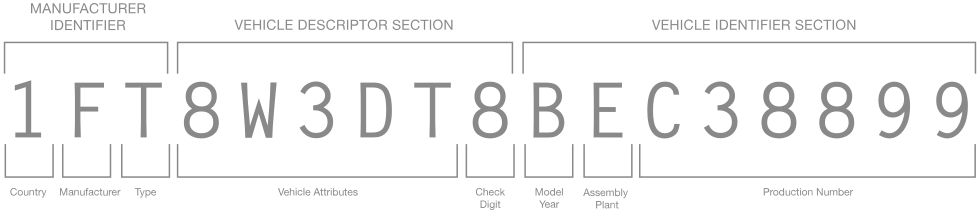
Here is a table that will allow you to identify specific information encoded in each digit:
VIN Digit Meaning VIN Digit Meaning1st Country 10th Model Year
2nd Region / Maker 11th Assembly Plant
3rd Vehicle Type 12th Sequential Number
4th Vehicle Attributes 13th Sequential Number
5th Vehicle Attributes 14th Sequential Number
6th Vehicle Attributes 15th Sequential Number
7th Vehicle Attributes 16th Sequential Number
8th Vehicle Attributes 17th Sequential Number
9th Check digit
World Manufacturer Identifier (WMI)

The first three characters of a VIN form the WMI. They encode region/country, manufacturer, and vehicle class/type. For low-volume makers (fewer than 500 units/year), the third character is 9 and the next three VIN characters extend the identifier.
Country/Region: The first character indicates origin (A–Z). For example, AA–AH denotes South Africa.
Manufacturer: The full three-character WMI identifies the maker (e.g., 1FD = Ford Motor Company, USA).
Vehicle Type: The third character helps specify class (e.g., 1G1 = Chevrolet passenger car).
WMI Codes: Brand & CountrySelected, high-confidence WMI mappings. Use this as a quick guide; full assignments are maintained under SAE/ISO rules and can vary by vehicle class and plant.
WMI
Manufacturer
Country
WB1 WBA WBS WBX
BMW
GERMANY
2CN 2G1 2GC 2GN
Chevrolet
CANADA
1G1 1GB 1GC 1GN
Chevrolet
UNITED STATES
2B3 2B6 2C4 2D4 2D8
Dodge
CANADA
1B3 1B4 1B7 1D4 1D8
Dodge
UNITED STATES
1F6 1FA 1FB 1FC 1FD 1FM 1FT 1ZV
Ford
UNITED STATES
WMI
Manufacturer
Country
JH2 JH3 JHL JHM
Honda
JAPAN
19X 1HF 1HG 478 5FN 5J6
Honda
UNITED STATES
JT6 JT8 JTH JTJ
Lexus
JAPAN
WDA WDB WDC WDD
Mercedes-Benz
GERMANY
JT2 JT3 JT4 JTD JTE JTM JTN
Toyota
JAPAN
1NX 4T1 4T3 4T4 4TA 5TB 5TD 5TE 5TF 5YF
Toyota
UNITED STATES

Positions 4–9 are the VDS. Typically, 4–8 encode key attributes; the 9th is the check digit used to validate the VIN.
Vehicle Identifier Section (VIS)
Positions 10–17 are the VIS and provide vehicle-specific details:
Older VINs (Before 1981)Before 1981, VINs were not standardized and often had 11–13 characters instead of today's 17. They can still reveal key details, but decoding usually requires manufacturer records or specialist references–especially for classic and vintage vehicles.
How Is a VIN Used?The VIN serves as a persistent identifier throughout a vehicle's life:
VIN Decoder ExamplesThe following example shows what you can see with our free VIN decoder:
VIN Year Manufacturer Model Engine Trim1FTFW1CT5DFC10312 2013 Ford F-150 3.5L V6 TURBO FX2 SuperCrew 5.5-ft. Bed 2WD
1GCHK24UX2Z291093 2002 Chevrolet Silverado 6.0L V8 OHV 16V 2500HD
4T1BG28K81U790207 2001 Toyota Camry 2.2L L4 DOHC 16V CE
WBA5B3C50GG252337 2016 BMW 5-Series 3.0L L6 DOHC 24V 535i xDrive
7SAYGAEE7PF684052 2023 Tesla Model Y ELECTRIC Long Range AWD
What You Get from the FAXVIN VIN Decoder
Below are the core specs we typically return on a successful VIN lookup:
Model year;
Make;
Model;
Trim;
Body style;
Assembly country & plant code;
GVWR class;
Engine specs;
Fuel type;
Transmission;
Driveline;
Fuel economy (city/highway);
Fuel tank capacity;
Maximum towing capacity;
Curb weight;
Dimensions (length/width/height);
Wheelbase;
Ground clearance;
Tire size (OE);
Brakes (front/rear);
Suspension (front/rear);
Seating capacity;
Warranty terms;
MSRP;
Factory colors & interior trims.
Where Our VIN Decoder Data Comes FromOur VIN decoder is powered by manufacturer-supplied specification data. We obtain build information directly from automakers and their authorized data partners, then standardize, validate, and map it to a clear, human-readable format–available to you free of charge.
Collection: OEM catalogs, homologation files, service/parts databases, and technical bulletins across regions and model years.
Normalization: Unifying option codes, engines, body styles, restraint systems, and plant codes; handling mid-year and regional variations.
Validation: Check-digit verification (9th character), sample-VIN spot checks, and automated regression tests.
Delivery: Instant VIN lookup/decoder output with concise labels – no sign-up required.
Which Vehicles Can Be Decoded by VIN?VINs have been standardized for vehicles manufactured since 1981 in the USA, but they do not apply to all types of units. They are mostly assigned to the following automobile types:
Car;
SUV;
Pickup;
Motorcycle;
VAN;
Commercial Truck;
RV and Motorhome;
Trailer and Camper;
Moped and Scooter;
Buses;
ATV.
FAXVIN VIN Decoder vs. Other DecodersChoose FAXVIN when you need instant, manufacturer-accurate decoding with one of the industry's highest levels of detail (up to ~120 attributes). Our pipeline blends direct OEM/authorized data relationships, rigorous normalization, and automated validation – so your VIN lookup is fast, consistent, and ready for production use.
Key criteria FAXVIN Competitors Manual processingPrimary Data Origin OEM / authorized partner specifications; multi-source merge Secondary/aggregated datasets; limited first-party data Public lists, forums, ad-hoc PDFs
Coverage US, CA, EU; global WMIs Regional gaps common Depends on researcher's sources
Attribute Depth Up to ~120 decoded attributes Fewer fields; generic trims Limited detail
Update Frequency Daily/weekly Weekly/monthly Ad-hoc; time-intensive
Lookup Latency Instant; CDN-accelerated Seconds; may queue Minutes–hours
Validation & Correction Check-digit + sanitization;
underlines error char(s) with fix hints Basic format check; generic "invalid VIN" Manual math – possible errors
Free Single Lookup Full free decoder Often gated or count-limited N/A
Exports & Sharing PDF; copy/share link Rare/limited N/A
How to Do a VIN Lookup
Use FAXVIN to decode a VIN and view free vehicle specifications in a few quick steps:
Find the VIN: Locate the 17-character code on the dashboard (driver's side), door jamb, title, registration, or insurance documents.
Enter the VIN: Type it into the VIN input box on this page.
Click "Decode VIN": Start the lookup to retrieve free basic specs instantly.
Review free results: See make, model, model year, trim, engine, body style, and assembly plant.
Optional – full history: Upgrade to a comprehensive report for title brands, accident records, mileage/odometer entries, theft checks, liens, and more.
Start a to confirm core specs before you buy.
Additional Resources for DriversHere are additional resources that you can use to learn more about pre-owned cars and related VIN lookup information:
Frequently Asked Questions
Can I Run a VIN Decoder for Free?
Yes. The VIN decoder reveals various details about your vehicle, such as the production date, engine size, assembly location, fuel type, and up to 120 decoded attributes.
What Documents Contain the VIN?
You can find your VIN on your auto insurance documents, vehicle title, registration, or owner's manual.
Can a VIN Number Be Changed?
No – it cannot be legally changed; altering or removing a VIN is a federal offense.
Is It Safe to Share My VIN?
Yes. There is no risk in revealing your VIN, as it is visible to anyone from the sticker on the dashboard. Sharing it can help potential buyers research the vehicle, showing that you have nothing to hide.
Are All VINs Unique?
Yes. Much like passport numbers, a VIN lasts throughout a car's life, and no two vehicles share the same sequence.
What if my VIN has fewer than 17 characters?
Vehicles built before 1981 may have VINs with 11–13 characters. These require manual decoding through specialized databases or state DMV assistance.